
Every year, around twenty-five thousand people come to Chamonix Mont-Blanc to walk 165 km around the highest mountain in western Europe, crossing 3 different borders, and walking for a week straight, to ultimately end up where they started. This activity is called Le Tour Du Mont-Blanc (literally: Around The Mont Blanc). I did it in seven hours and I only needed a Gatorade.
Chapter 1: Going Without a Plan.
I often get frustrated about the content I’m making. I wonder if it’s good enough, interesting enough, or original enough. I sometimes want to delete some of the work I shared on the internet (whether it is a video or an article) simply because I feel like it isn’t as good as it could have been.
I often think about what I should write next, what video to shoot next, and what original idea I should work towards. All in the pursuit of expressing, through digital media, my love for anything that has four wheels and an engine. But in the pursuit of content-creating, I have forgotten to do the most fundamental thing a car guy should do: go for a drive.
I had this realisation yesterday when my wife and I went for our first drive in what feels like a million years. We didn’t know where we were going, but we were going there. Only half an hour after our departure the French border was behind us and we were already in Switzerland.
Driving down a mountain road with big bends that sweep in between vineyards, Margot, my wife, said that at this pace we could probably drive around the Mont-Blanc before the end of the day.
I didn’t hesitate one second, when I got to the roundabout at the entrance of Martiny (the first town in Switzerland after crossing the border), I took the first exit towards a mountain pass called The Great Saint Bernard Pass.
Our Tour Du Mont-Blanc Adventure began!
Chapter 2: Where Great Men Walked, they Now Drive.
Le Col du Grand St Bernard, as the French call it, is the third-highest mountain pass in Switzerland. At an elevation of 2,469m (that’s 8,100ft for you guys), it also makes this mountain pass the 20th highest mountain pass in Europe.
A long, long time ago, before we invented tunnels, this pass was one of only a handful of ways to cross the mountain range that creates the border between Italy and Switzerland.
Great men fought for this treacherous passageway between mountains: Years ago, Julius Caesar sent an expedition to seize the pass in hopes of finding a shorter route between Italy and Gaul. But he failed.
His adoptive son, Augustus, succeeded where Caesar failed and he built Augusta (later renamed Aosta) at the bottom of the pass – to underline his victory. Many years later, Napoleon Bonaparte used the same pass during The Italian and Swiss Expedition. He led a surprise attack where forty thousand men walked through the Great Saint Bernard Pass while three other brigades walked (at the same time) through three other mountain passes further down south of the border. The French forces won this battle, consequently creating an army-wide admiration for the young Napoleon Bonaparte.
The Emperor of France and TWO Roman Emperors deemed this area of the world important enough to let men die for its ownership.
I am, as usual, the reasonable one as I didn’t kill anyone – or declare war on a country – to appreciate the beauty of the Great Saint Bernard Pass. I simply drove it.
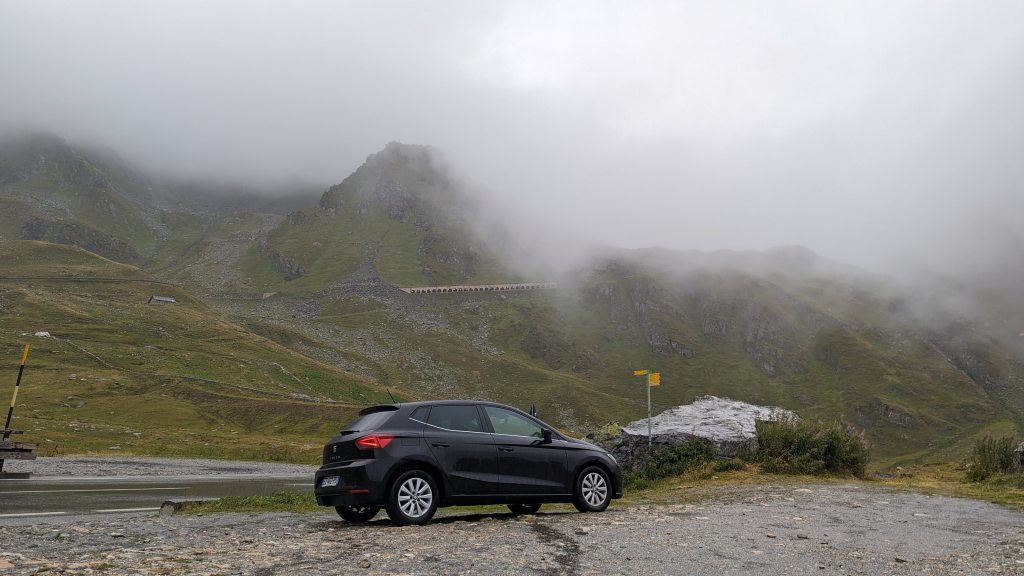
Sadly, the gods didn’t grant us the gift of good weather. Humidity was high and the clouds were low, but despite our high altitude we were not in the clouds; we had good visibility, for now…
Chapter 3: Roads are for Horses.
Switzerland doesn’t have a strong feeling of admiration for automobiles like their neighbours do; The Swiss side of the pass has only recently been repaved, but it’s still the same width as ‘back in the day’ when cars had four legs and a tail. As you cross the border into Italy, though, the road gets wider and smoother, to accommodate the new-aged ponies. The Italian-made ones, I’m assuming.
Even though the Swiss portion of the pass has become a much nicer road to drive on than it was before, I will always prefer the Italian side. The scenery resembles a race track I used to love racing on while playing a video game called Grand Turismo 5 (back on the PS3). Weirdly, I think I get a sense of nostalgia when I’m here.
The aggressive and steep rocky mountains abruptly transform into green-grass plateaus that hug an old avalanche tunnel. The valley is wide and open, which lets you see far, thus, giving a sense of how high in altitude you are. The road doesn’t simply wind up the mountain in a left-right pattern like on the boring Swiss side. No, no, no. The Italians seem to have gone out of their way to make the road complex and involving, while still being unpredictable and natural. Not one corner, bend, or turn is like the one you took just before. It’s exciting, like tickling your high school crush. And to top it off, the scenery is out of a poster card.
It’s worth stopping a few times in the rest areas to look back at what you just drove down. On the first part of the way down to Aosta, there’s a parking lot called the Parking Gran San Bernardo. From there, look up, and you’ll see the rocky mountains in the background and the grass formations swallowing the grey-stoned avalanche tunnel.
The lower in altitude you go, the more the forest engulfs the road and, above the treetops, the mountain range shows its towering posture.
Chapter 4: Augusta Walked so that Aosta Could Run.
Before one gets to Aosta, a couple of small, typically Italian villages need to be crossed.
After that, a pit stop in Aosta is necessary, if time allows it. This time around, we didn’t stop to see the Roman ruins of the aforementioned city of Augusta. But if you can, you should. The old city is still very much part of the current city’s structure. You walk on the tiles, under the arches, around the fountains, which were all built when Italy was the heart of one the greatest empires the world had ever seen (before being dethroned by the British Empire, of course). The old and the new have become one and formed a city where a telephone store can be found in a building that Americans would consider a historic building, but here, it’s just a telephone store.
To get to the next step of our adventure, we needed to drive from Aosta to Pré-Saint-Didier. Two options were offered to us, the small ‘strada statale’ (the national roads), or the motorways. Naturally, we took the strada statale; at lower speeds, you get to see more of the scenery, and it is worth seeing. This back road was, at the time of its construction, the biggest road in this portion of the Aosta Valley. Because the villages are old, this new “big” road couldn’t go through them, so it was built next to them on the portion of the valley that is a little more elevated, giving the motorist an elevated and beautiful view of all the old villages in the valley.
Chapter 5: Pass Number Two.
From Pré-Saint-Didier, we headed up towards La Thuile. Interestingly enough, although the name of the following villages might sound French, they are actually on Italian territory. I guess our little friend Napoleon didn’t quite succeed in his Italian expedition after all.
Not to worry, his failure didn’t stop us from having a good time.
Right off the bat, the road to leave Pré-Saint-Didier threw eight hair-pins at me. My heart rate and my concentration level rose, I got my eyes off the scenery and back on the pool-table-smooth road. The hairpins are too narrow and tight for my little one-litre three-cylinder engine to handle in second gear, so I have to downshift into first, but that’s not my biggest concern right now.
Chapter 6: The Weather Gods are Back.
As we exit the hairpin section of the strada statale, I can finally go into fourth gear, and then, because the corners become more elongated, even fifth. The forest becomes less dense, and the sky more visib- actually, the sky should be more visible, but the weather gods have done it again. They removed the sky from the sky. It’s just clouds now, and whatever is left of the sunlight after it tries its best to go through the wall of water vapour floating above us.
As we climbed higher and higher, a small village of eight hundred inhabitants popped into our sight as we came out of a corner; welcome to La Thuile. An old mining town, beaten up by multiple wars, but with the strength to get back up after each one of them. It also marks the beginning of what is known as the Col Du Petit Saint-Bernard (Colle Del Piccolo San Bernardo, in Italian). On a map, we’re on the same departmental road as we were before we drove into La Thuile, but it is much more than that.
Chapter 7: War, Again.
A Neolithic structure in the shape of a circle with an eighty-metre radius, is at the very top of this pass. Its use and origin are complicated to determine, primarily because of its age, but also because it has been gravely damaged by the soldiers walking over it, bombs exploding near it, and bulldozers building a road through it. Still, it indicates that this area of the French-Italian border has always been important to the people of the surrounding valleys.
So much so that between the 10th and the 20th century, more wars than I could read about happened here. The most recent alteration of this phenomenon happened in 1940, when Fascist Italy declared war on the French army which had already been defeated by Nazy Germany. In 1943, at the same place where the French army lost against Mussolini’s forces, the French rebellion pushed back the Nazis.
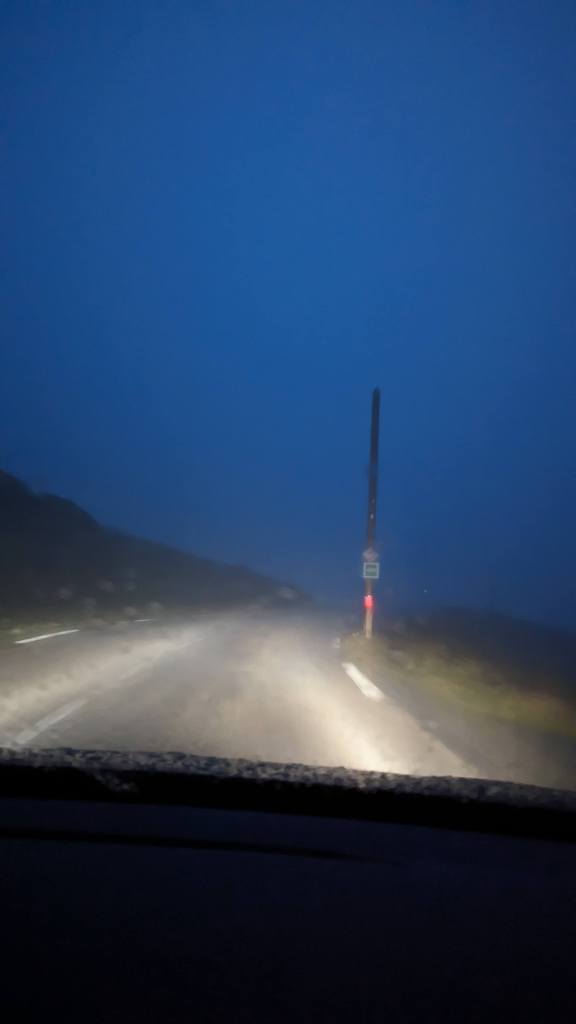
I, too, was at war. At war with myself and the weather. We were now above 2,100 m of altitude (Once again for the Yanks, that’s over 7100 ft) and we were definitely in the clouds. The visibility out of our little Ibisa was atrocious; I couldn’t see my hand if I stuck it out the window. I therefore was doing my best not to fall off the road; I was using all of my energy to focus on the road and avoiding death. Margot followed the footsteps of Isabelle Galmiche and became the best co-pilot on earth. With Google Maps in hand, she told me what to expect, and I did my best to adapt my speed and trajectory accordingly. But it was getting late; the sun had dropped behind the mountains, and my Gatorade bottle was now empty. This, dear reader, was the recipe for my soon-to-be terrible migraine.
The further down we drove, the lower my energy level was, and the worse my migraine was getting. The breathing exercises I saw on the internet could only help me so much; I was now in need of rest, food, and water. When we got back into French territory, we drove a little while before we saw our first sign of civilization: a little ski domain called La Rosière. Here, the treacherous weather conditions paused for a brief moment as the clouds weren’t able to wiggle their way in between the buildings. On the only street crossing the village, I was finally able to unclench my grip from the steering wheel and relax a little bit; I wasn’t driving blind anymore. Sadly, La Rosière is small, and as we left the village we drove into the same hell we had escaped a few seconds earlier.
Chapter 8: McDonald’s.
It felt like hours had gone by, although that was just an illusion caused by the discomfort of the migraine. I could see the minutes tick on the clock thinking “It’s only been five minutes?!” Margot saw that I was struggling, and as any loving wife would, she offered to drive. I declined, as we were on mountain roads, at night, and to top it off, she hadn’t driven in about a year; I thought that it was maybe not the right time and place to get back in the driver’s seat, but rather, a little later when we were back in town where the lighting and the visibility would be better and the road would be less technical. She agreed and said that we’d take this as an opportunity to make a pit stop and get some food in us. I, of course, agreed.
We stopped at the only place we knew for a fact would be open at this time of the night: McDonald’s.
As I lay in the car, in the dark, with the windows open even though it had started to rain, Margot went to get me a much-needed picker-upper. The cold, late-night, rainy air flowing in one side of the car and leaving out the other helped me deal with my heart, which had now migrated to my temples. I got out of the car and slowly walked to see Margot, who was patiently waiting for our order. She told me that, sadly, but not surprisingly, they didn’t have Earl Grey tea. But that didn’t matter, as we were about to get a box of twenty of the best chicken nuggets on the planet, paired with the best barbecue sauce in all the galaxies. I rarely eat at Maccie’s, but that night, I couldn’t have been happier to eat deep-fried grounded little chickens.
After our break, Margot and I switched places and she drove for the first time in about a year. As you have probably gathered, the clouds were not an issue anymore, our visibility had been restored ten minutes before we parked in front of the life-saving McDonald’s parking lot, on the outskirts of Bourg-Saint-Maurice.
Chapter 9: All You Need is Love, Tadadadada – The Beatles.
The night had fallen, the sky was still covered, and the road was not lit (for ecological reasons, I suppose). But, like riding a bike, you don’t forget how to drive a car. Margot drove valiantly, for about an hour. I didn’t sleep, but I reclined the passenger seat and took the opportunity to relax. The lack of light meant that I didn’t have much to see out the window anyway, so I did what any good co-pilot should do: I kept an eye on the GPS. Granted, my co-piloting wasn’t as impressive as Margot’s.
It’s in situations like these that I realise how lucky I am to have a wife like mine. I know I was supposed to keep an eye on the navigation device, but I couldn’t stop looking at her. The traffic lights would shine on her face and get tangled in her long blond hair. We started talking about our adventure as if it was finished, even though we still had some ways to go, and her voice soothed me. It was nice to be the passenger, for once.
Sixty-three kilometres later, Margot was starting to feel the fatigue, which is understandable considering the fact that we had been on the road for five hours, and she had now been co-pilot AND pilot. I still had a little headache, but it wasn’t a migraine anymore, and therefore I was good to go. We switch places in a little parking lot next to the petrol station in Ugine, right before the next step of our adventure: Les Gorges de l’Arly
Chapter 10: The Canyon.
The road was first built in 1866 and, of course, it didn’t look like it does now. Mainly because cars didn’t exist at the time, but also because the road is always falling to pieces due to the type of rock the canyon is made out of, and it’s always under construction because of it. The departmental road 1212, as the government calls it, is one of the most dangerous and expensive roads in France. The canyon in which it is built gets very narrow, and the road is forced to alternate between the left and right banks of the river due to the lack of space. Rock falls and mudslides are common, they usually damage the road pretty badly and, sometimes, motorists can’t flee in time to escape the falling rocks. A small tunnel was recently built in hopes of minimising the risks.
The following question should therefore be asked: why use this road?
Well, it’s relatively simple. The only way to go towards Italy, Switzerland, Germany and where we live, from this part of the region, is through this canyon. Unless you are willing to add at least an hour to the commute by going around the mountains in which the Gorge de l’Arly is lodged. The road is very narrow at times, and some of the corners are seriously tight, but it’s worth the experience. Unless, of course, you are driving on this road at night and the weather gods have decided to make you blind, again…
So here I was, once again, doing my best not to crash and die. Thankfully, I knew the road, and I wasn’t as blind as I was on the Col du Petit Saint Bernard. But I must admit that the experience wasn’t as enjoyable as it usually is.
Chapter 11: Home.
The narrow part of the Gorge de l’Arly soon came to an end, and my visibility came back as soon as we got closer to civilization. The departmental road took us through a couple of nice mountain villages, but nothing out of the ordinary. We ended up driving through Megeve, and then back down to…
Look. Honestly, at that point, I was knackered. I just wanted to go home and comatose in my bed for at least two years. But I needed to get us home first.
So I did my best.
I kept my eyes glued to the road. I stayed in third gear on the small roads because I didn’t want to waste energy switching gears. I also figured that I was so tired I wouldn’t notice if I was driving at an unreasonable speed, so staying in a low gear made sure that I couldn’t go over a certain speed.
I was struggling, and I wasn’t alone, Margot was feeling it, too.
Driving up the Viaduc Des Egratz, which is an exploit of civil engineering, I knew I was home soon. I was so eager to get home that I didn’t give an ounce of energy to think about the bridge, like I usually do. I’ve come to realise, throughout the years, that I’m a big fan of bridges. This one is a beautiful one, it represents the entrance to the Chamonix Mont-Blanc valley. Standing at a towering sixty-eight metres above the ground, and measuring over two thousand metres long, it slithers up from Chedde into Les Houches – where home is.
When we got there, we turned the car off, slowly made our way into the house and, shortly after, into bed. I fell asleep with a massive headache and my wife next to me. It was 11:57pm, so we had officially accomplished the Tour Du Mont-Blanc before the end of the day.
Max,

 The Pit Lane - Blog
Leave a reply to annkartal9 Cancel reply